Minerals for Horse Nutrition: A Complete Guide
There are a variety of important minerals for horse nutrition. It is important not to put too great an emphasis on any one particular mineral. However, some minerals do require greater supplementation than others.
For example, you will rarely see iron or iodine listed in the guaranteed analysis on a horse feed tag. Yet most commercially prepared feeds will have guaranteed levels of copper and zinc. Why is this? Some nutrients are naturally present in most forages. Others are often not present in high enough levels. Today’s horse has high performance demands. These horses need additional supplementation.
Why Minerals Matter
Minerals play a vital role in horse health. Without minerals, horses could not metabolize fats, proteins, or carbohydrates. Their muscles and nerves would not function normally. Their bones could not support their own weight.
Minerals help the blood transport oxygen throughout the body. They maintain the body’s acid/base and fluid balances. They are necessary components of virtually every enzyme. The horse needs these enzymes for everyday metabolism.
Minerals are integral parts of some vitamins. They are also parts of hormones and amino acids. Yet minerals make up only about 4% of the horse’s total body weight. Compare this to fats, carbohydrates, and proteins (30% to 35%). Water makes up about 60%. In the case of minerals, a little bit means a lot. In this article, we will discuss minerals for horse nutrition.
Quick Guide to Basic Minerals for Horse Nutrition
Calcium & Phosphorus
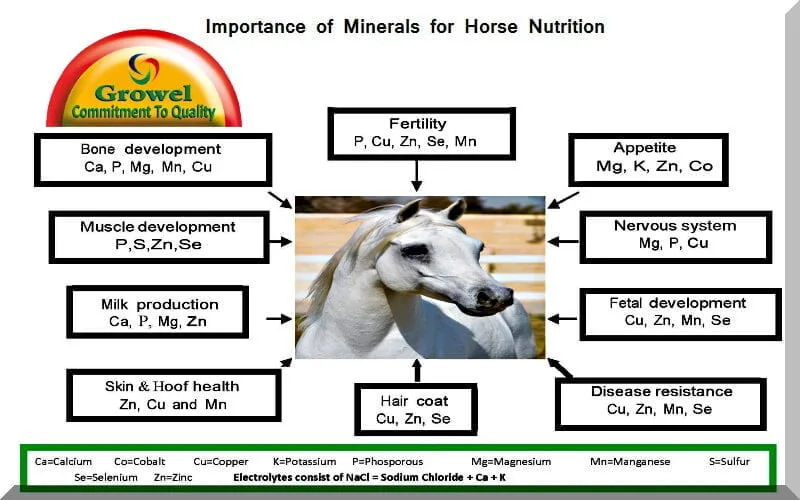
Calcium and phosphorus are important minerals for horse nutrition. Both are needed for healthy teeth and bones. The greatest need occurs in the first year of a horse’s life. During this time, the horse grows most of its height.
Lactating mares need higher amounts of calcium and phosphorus. This keeps elevated levels in their milk. Calcium and phosphorus should have at least a 1 to 1 ratio.
Grains are low in calcium but high in phosphorus. Some grains meet phosphorus requirements but not calcium needs. Therefore, you must add extra calcium. This develops the proper 1 to 1 ratio.
Horses foremost need three minerals: salt, calcium and phosphorus. Salt is lost through sweat and urine. So you should offer salt free choice to the horse at all times.
Magnesium
Magnesium is necessary to reduce stress and irritability. Deficiency is rare but may occur in certain horses. These include horses on high grain diets. They also include animals in high-stress situations.
When deficient, horses become high-strung and jumpy. Rations with significant forage generally prevent magnesium deficiency. Grass tetany (seen in cattle) is not an issue in horses. Horses absorb magnesium much more efficiently than cattle. Toxicities are not generally seen in horses.
Potassium
Potassium has a major function in muscle activity. It also helps maintain acid-base balance. High-grain diets may cause potassium deficiency in horses.
Deficiency symptoms include reduced intakes and muscle weakness. They also include diarrhea and slowed growth. Forage is important to prevent potassium deficiency. Toxicity is not generally an issue if you provide adequate water. The horse excretes excess potassium in the urine.
Potassium gained most of its notoriety with HYPP in the quarter horse world. Feeding high levels of potassium can induce an attack in an HYPP-positive horse. Therefore, total dietary potassium in an HYPP-positive horse should stay below 1%.
Cobalt
Cobalt is necessary for vitamin B12 synthesis in the intestinal tract. The requirement is very low.
Copper
Copper is necessary for hemoglobin formation. It works along with iron and vitamin B12. Deficiency symptoms may include anemia and abnormal bone development in foals.
Deficiencies often occur in suckling foals. The mare’s milk has very low levels of copper. You should take care with pregnant mares. Feed them a diet sufficient in copper during the last 3-4 months of gestation. During this time, the unborn foal stores copper in its liver. This helps the foal get through the nursing period without problems.
Copper levels are also very important in developmental orthopedic diseases. Toxicity is very rare in horses. Deficiencies in mature horses are also not seen often.
Iodine
Iodine is needed to make thyroxin. Thyroxin controls the body’s metabolic rate. When iodine is deficient, foals may be born dead. Mares may be unable to nurse properly. They may also have higher than normal naval ill.
Both toxicity and deficiency lead to hyperthyroidism. Why? Toxicity impairs or inhibits release of thyroid hormones. Deficiency does not allow sufficient hormone production.
Iron
Iron is necessary for hemoglobin formation. Hemoglobin enables the blood to carry oxygen. Iron deficiency anemia is a common deficiency symptom.
Horses under heavy racing or showing stress may develop deficiency symptoms. Horses with chronic blood loss from parasite damage may also develop symptoms. Toxicity symptoms include depression and diarrhea. They also include increased susceptibility to bacterial infections.
Manganese
Manganese is essential for bone formation. It also supports growth and reproduction. Manganese deficiency symptoms may include poor growth. They may also include lameness or bowing of legs, plus reproductive dysfunction. Most feedstuffs are rich in manganese.
Selenium
Selenium is associated with white muscle disease. It is also linked to death in foals. Deficient animals have muscle disorders, such as tying-up. However, more than 5 ppm selenium in the ration may be toxic to the horse.
Feed companies cannot supplement selenium at a rate exceeding 0.3 ppm in the total daily intake when fed as directed. You should feed selenium with Vitamin E. They work together in the horse’s body.
Zinc
Zinc gives gloss or “bloom” to the hair coat. It is also needed for protein synthesis and metabolism. In horse nutrition, zinc needs a proper ratio with copper. The ideal ratio is between 1:3 and 1:4 (copper to zinc). Researchers are also studying zinc closely regarding developmental orthopedic diseases.
Final Thoughts
Minerals for horse nutrition are needed in very small amounts. Yet they remain essential for your horse’s health.
You should also see Vitamins & Minerals for Horse
For regular updates on horse nutrition and health, please join our Facebook Group: How To Do Profitable Poultry & Cattle Farming?